
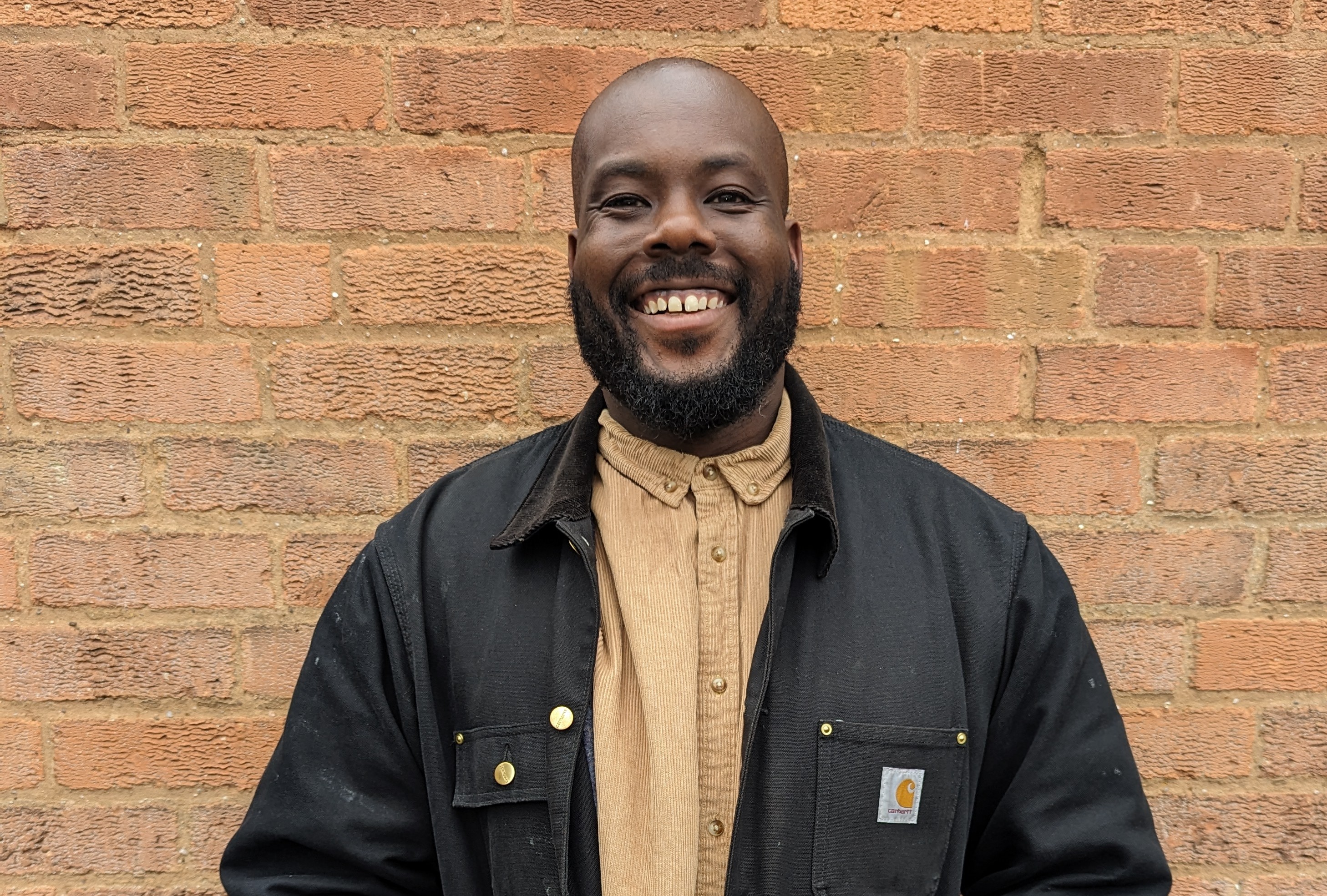
A conversation with Joshua Walker, CBT Therapist at Make More around confidence.
Confidence is something many of us struggle with at different points in our lives, but where does it come from, and how can we build it? We spoke to a CBT therapist with 10 years of experience to explore the relationship between confidence and mental health, the impact of social media, and the role of human connection in our wellbeing. From understanding why stepping outside our comfort zones can feel difficult to finding small ways to support ourselves, this conversation looks at how confidence develops through experience and what we can do to strengthen it.
Could you just tell me a little bit about yourself and your background?
I’ve been a CBT therapist in Birmingham for 10 years. I worked in drug and alcohol, and then in crisis support. I also have a qualification working with long-term health conditions and their impact on mental health and wellbeing.
Today, I supervise other CBT therapists. We work with young adults, from 16 upwards, many with trauma-based presentations.
With what kind of questions or problems do people most commonly come to you for support? Has that changed in recent years?
I’d say the most prominent difficulties people come to me with are struggles with some aspects of social anxiety, often with a confidence component to it. Lack of self-confidence, that type of thing.
I definitely think that social isolation-related difficulties have become more prominent since COVID, across all ages. There is also a lot of social anxiety or social withdrawal.
We’re also seeing a lot more trauma. I think that comes down to people having a lot more open conversation publicly around abuse and trauma as a whole. People are far more aware and are beginning to put together that what might feel like ‘I’m anxious’ one time and ‘I’m depressed’ another, actually, could come down to trauma.
From your perspective, how do you think about confidence and how is it connected to mental health?
Confidence isn’t really innate.
Confidence is built and it’s built through experiences.
There is a major misconception around confidence that it should somehow be innate and people often find themselves in a position where they have these expectations that they should just have it.
But actually the importance of experience is everything. Sometimes that experience is about dealing with a problem, but sometimes it’s how you’ve been spoken to, how you’ve been treated. The type of opinions and perspectives and words that are spoken to you early in life, as you grow up. That helps form the basis for who we think we are, who we know ourselves to be. Sometimes we can perceive ourselves as being unworthy, because of what we’ve experienced historically, feeling as though we’re not good enough in some way.
It means that if we are low on confidence, we need experiences to build it, which puts us in a situation to feel a level of discomfort early on in doing so. It requires us to step outside of our comfort zone, which can make us feel uneasy, or as though we can’t manage. Our body, and in particular, our brain, has no frame of reference for this new space and tells us to run away, protect ourselves. That can be very hard for people. As human beings, we are fantastic at adapting, but not all adaptations are instant, they take time.
We talked about confidence, but also what about resilience?
It’s an interesting one. In my job, it never ceases to amaze me the sort of the bounds of the human spirit.
Early in my career, I had a supervisor that would always remind me that before I saw the client, the client was managing these difficulties, maybe not how they would have wanted to, but they were able to hold it together in a way that got them to you.
By making recruitment more accessible and inclusive, employers can widen their talent pool and attract skilled candidates who might otherwise be overlooked. It can also help organisations build a workforce that better represents the customers and communities they serve.
Resilience allows us to stay with things that are uncomfortable and navigate difficult situations. But at times it does have a limit. Observing the limit of our resilience, what we do with that feeling, when we’re feeling at our wit’s end, and our ability to be able to seek help from family, from friends, from engaging in things that we value, can also bolster that resilience.
We might need support. And if we’re lucky enough to have family and friends, and things that we value in our life, things that we enjoy, or things that give us purpose, that can help. Therapists can also help bolster that.
Would you say that social media has made things worse for some people in terms of confidence and how people manage their mental health?
I think that social media has created conversations and better awareness of some mental health issues. At the same time, it’s also contributing directly to people’s mental health difficulties. How algorithms work, they want to give you more of what you’re putting into them.
There’s no doubt that it can create a pressure for people to look a certain way, be perceived a certain way. And increasingly what I have to put across to clients is that on social media whether it’s a content creator or just a friend, they are showing a side of themselves that they want others to see. That doesn’t mean that the person behind the post isn’t experiencing difficulties, doesn’t feel down or anxious. It doesn’t mean they don’t feel sad or depressed.
Would you say that there are age groups where people are particularly vulnerable?
Listening to younger people that I work with, it’s interesting how some of them are much better at navigating social media. They’re aware of the algorithms, aware of downtime, and some of them are able to see it for what it is. Maybe in a way older generations have had to learn or are seeking to understand better now.
But there are ages of very significant development. Specifically adolescence, I’m thinking, 11 to 18. All the academic pressures, all the biological things that are happening for teenagers at that time. And then for that to be compounded by social media… When I went to school, something embarrassing might happen. And that’s where it stayed, at school. But now, it doesn’t. It follows me back home on the internet. And that is suffocating.
Social media also sets a condition of an economy of likes. The way that your self-confidence, your self-esteem, the way that you view yourself in the pecking order at school can sometimes be quite literally boiled down to how many likes or interactions I have with a particular post. There is a dopamine hit that we get from a like, from this external source of validation. So, the question becomes, how do we separate ourselves from that when, if it’s going well, it feels so good? But if it’s not going well, and this is the agreed upon currency of said school or social space for young people, how do you free yourself of that?
Are there any strategies that either young people or their families could adopt to try and navigate those vulnerable times, between 11 and 18?
I think having breaks away from social media is so important because it gives you the opportunity to step away and understand that the world hasn’t fallen apart. That those that care about you, those who love you, are still here. It’s hard to step away, because the pace of social interactions can be relentless. If you step away, it’s almost as though you’ve lost control in some way. But having moments in time to turn off is increasingly important, and for interactions to be less social media-based, and more in-person. There is no substitute for the feeling of in-person connectedness, of acknowledgement, and being in a space with another person.
For clients across all ages who come to us, anxieties pick up about three or four hours before bedtime. That’s common across all people, because that’s the one time where you can’t do much. Your shops are closed, work is out; if you’re a child, you can’t get onto the playground or school till 8-8.30 in the morning. So, how you spend that time is so important.
Mindfulness, some aspect of relaxation. Even elements of physical exercise – doesn’t have to be particularly strenuous, but any movement provides an opportunity for feel-good endorphins, for relaxation and appropriate sleep, for focus away from social media, and that can be helpful to people’s mental health.
What do you do for relaxation?
I love to play rugby. For me, that camaraderie and connectedness to a common goal, is something I really enjoy. I do take half an hour to do some nice yoga stretches, particularly in the morning, sometimes at night.
And I do like mindfulness practices. So I have apps that I listen to. I try to take myself for walks in my break time. There is also a time and a place for a book as well.
What would you say in your experience AI has done, for people’s mental health? Is it positive? Is it negative? Where is human support essential as well?
The therapeutic relationship is the single thing that will define whether you will move forward together and work or not. That is about a person-to-person connection. I don’t believe AI can replace our need and want for connection to other people.
A lot of problems that we see with mental health now are essentially connection problems. Can I feel connected to my community? Can I feel connected to my friends? Can I feel connected to my loved ones?
I’ve had clients come to me and say that they’ve taken their symptoms, put them into AI tools and found answers through that. Now, some of the information provided is not ostensibly wrong.
However, the human experience is the bit that is missing. The experience of sitting with another human being, of them helping you see the value in you, but also seeing their mannerisms, their connection with you in the room – for all intents and purposes, the vibe. It’s informative in a way that AI could never be.
What’s the one small thing everyone can do this week to support their well-being?
Being an inner-city boy myself, I know that green spaces are hard to come by. But there is something about sitting in a green space that can be really centering for a person.
Sometimes being able to sit in nature, especially for anybody that’s socially anxious, being able to watch the world go by and know that there are one in four people that also deal with some aspect of anxiety or depression. That means one in four people you see walk by have something that might be similar to yours. Observing those people move forward, be in the act of getting out of the house, making it to a green space to find some relaxation and enjoy some aspect of it that, can be grounding.
The other thing, and I know that it’s not always possible, but even a small amount of human connection. So, if you have an opportunity to sit with somebody and have a coffee, or even if it’s a collective sort of lunch break walk or whatever it might be, find a way to hold some human to human space with somebody. It can do wonders for you.
